Sponsored article
How to Choose the Right Bowl Depth for Soups, Salads and Porridge
- How Does Bowl Depth Affect Temperature and Comfort?
- Why Are Wider Bowls Useful for Salads and Pasta?
- What Bowl Shape Works Well for Porridge and Breakfast?
- How Durable Is Bolesławiec Stoneware?
- Why Does the Glazed Surface Matter?
- How Can Different Bowl Shapes Work in One Tableware Collection?
- How Do You Choose a Bowl for Everyday Use?
- FAQ
The shape and proportions of a bowl have a direct impact on how comfortable a meal is to eat. Depth, diameter and the angle of the sides influence how easily ingredients can be picked up, mixed and served.
Read more: Why Are Handmade Decorated Ceramic Wares Special?
Choosing the right ceramic bowl is therefore about more than appearance. A deep bowl may work particularly well for soup, while a wider and shallower form can make salads, pasta or breakfast bowls easier to mix and present.
Understanding these differences makes it easier to build a tableware collection that reflects the way meals are actually prepared and eaten at home.
How Does Bowl Depth Affect Temperature and Comfort?
Deep bowls are particularly practical for liquid dishes such as soups and broths.
Compared with a very wide, shallow vessel holding the same amount of food, a deeper form can expose a smaller surface of the meal to the surrounding air. This may help slow heat loss while also reducing the risk of spilling liquid over the edge.
The result, however, depends on more than bowl depth alone.
Temperature is also influenced by:
the amount of food;
the diameter of the bowl;
the mass and thickness of the ceramic;
the initial temperature of the bowl;
room temperature.
Stoneware itself absorbs heat from hot food and then gradually releases it. A substantial bowl can therefore influence how quickly a meal changes temperature, although the exact effect depends on its design.
Deep forms work well for traditional soups, creamy vegetable soups and other dishes with a relatively high proportion of liquid.
They are not always the most convenient option for meals containing large pieces of vegetables, meat or noodles.
Very steep sides can make it harder to use a spoon or fork comfortably, particularly when ingredients need to be mixed or picked up from the bottom.
For ramen, thick stews and similar dishes, a somewhat wider opening and gently sloping sides may provide more space.
Choosing a ceramic bowl should therefore take into account not only capacity but also the relationship between depth and diameter.
Why Are Wider Bowls Useful for Salads and Pasta?
Salads need space.
A wider bowl provides more room for mixing vegetables, toppings and dressing without pushing ingredients over the edge.
The same shape can work well for pasta, grain bowls and meals made from several separate components.
A broad surface also makes it easier to display individual ingredients rather than stacking everything vertically.
This can be useful for dishes where presentation forms part of the experience, such as colourful salads, pasta or breakfast bowls.
Shallower bowls can also allow hot food to cool more quickly.
For some meals this is an advantage rather than a disadvantage. Porridge, for example, is often served very hot and may reach a comfortable eating temperature faster in a broad bowl than in a narrow, deep one.
What Bowl Shape Works Well for Porridge and Breakfast?
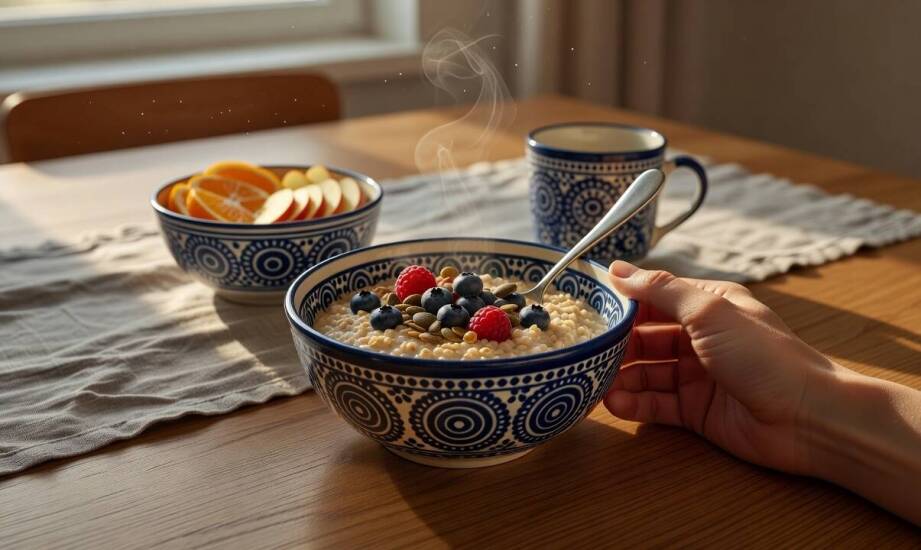
Breakfast bowls usually need to provide enough depth to contain milk, yoghurt or warm porridge while still leaving room for toppings.
A medium-depth or relatively wide bowl can work particularly well because fruit, nuts, seeds and other ingredients can be spread across the surface.
This makes mixing easier and gives each ingredient enough space.
For yoghurt, granola and cold breakfast dishes, heat retention is not important, so convenience and usable surface area can become the main considerations.
For warm porridge, a slightly deeper bowl can slow cooling, while a broader form allows the meal to reach a comfortable temperature more quickly.
There is therefore no single ideal breakfast bowl.
The right choice depends on what is normally served in it.
How Durable Is Bolesławiec Stoneware?
Bolesławiec stoneware is produced through a high-temperature firing process.
At Manufaktura, the ceramics undergo an initial firing at approximately 900°C, followed by hand decoration, glazing and a final firing at around 1250°C.
This process produces dense functional stoneware with a smooth glazed surface.
The transparent glaze covers the hand-applied decoration and makes the finished surface practical to clean.
Contemporary bowls from the collection are designed for regular household use and are suitable for the dishwasher and microwave.
This means that a decorated bowl does not have to be reserved for special occasions.
It can be used for everyday soup, breakfast, desserts or snacks and then cleaned together with other tableware.
As with any ceramic item, however, stoneware can still chip or break if dropped or struck hard against another object.
High-temperature firing improves functional properties, but it does not make ceramic indestructible.
Why Does the Glazed Surface Matter?
The glaze performs both decorative and practical functions.
Bolesławiec patterns are applied before the transparent glaze and final firing. The finished glaze therefore covers and protects the decoration rather than leaving it exposed on top of the surface.
A smooth glazed surface is easier to clean and has lower absorption than porous, unglazed ceramics.
This is useful when the same bowl is used alternately for sweet and savoury dishes.
A breakfast bowl used for yoghurt one morning can later serve soup, pasta or a snack without requiring a separate type of tableware for every meal.
Manufaktura in Bolesławiec offers bowls in different forms and decorative patterns, allowing function and appearance to be considered together.
How Can Different Bowl Shapes Work in One Tableware Collection?
A coordinated table does not require every bowl to have exactly the same shape.
Different depths and diameters can actually make a collection more useful.
A household might combine:
deeper bowls for soups;
wider bowls for salads and pasta;
medium-sized bowls for breakfast;
larger serving bowls for shared dishes.
Hand-applied Bolesławiec patterns make it possible to connect these different forms visually.
A common cobalt colour palette or repeated decorative motif can make bowls with different purposes look like parts of the same collection.
It is also possible to mix different pattern codes while keeping a common colour base.
This creates a more informal table setting without making the collection look accidental.
How Do You Choose a Bowl for Everyday Use?
Start with the meals you prepare most often.
If soup is a regular part of the menu, a relatively deep bowl with enough capacity for liquid will be practical.
If you frequently prepare salads, pasta or grain bowls, a wider design may offer more room for mixing and arranging ingredients.
For breakfast, look for a form that provides enough depth for yoghurt or porridge while leaving space for toppings.
Other practical details also matter:
stability of the base;
comfortable rim height;
overall weight;
dimensions;
ease of stacking;
compatibility with the dishwasher and microwave.
The most versatile bowl is not necessarily the deepest or largest one.
It is the form that suits the dishes most often served in your home.
FAQ
Is a Deep Bowl Always Better for Soup?
Not always. A deep bowl works well for liquid soups and helps reduce spills, but dishes with noodles, meat or larger vegetables may be easier to eat from a wider bowl with more gently sloping sides.
What Bowl Size Is Best for Everyday Use?
There is no universal capacity. The best size depends on whether the bowl will mainly be used for soup, breakfast, salads or larger one-bowl meals.
A medium-sized bowl is usually the most versatile, while households that regularly prepare different dishes may benefit from having several shapes.
Why Is a Wide Bowl Better for Salads?
A wide bowl gives ingredients more space and makes it easier to mix them with dressing without spilling them over the edge.
It also provides more surface area for arranging individual ingredients.
Does Stoneware Keep Food Warm?
Stoneware can absorb and store heat, so its mass and thickness influence how a meal cools.
However, heat retention depends on the design and temperature of the individual bowl, not simply on the fact that it is made from stoneware.
Is Bolesławiec Pottery Dishwasher- and Microwave-Safe?
Yes. Contemporary bowls from Bunzlau Manufaktura are designed for dishwasher and microwave use.
For ceramics from other manufacturers, always check the care instructions for the individual product.
Can One Bowl Be Used for Every Type of Meal?
Yes, but it will involve some compromise.
A medium-depth bowl can handle many different dishes, while having a few different shapes usually makes soups, salads, breakfast and pasta more comfortable to serve and eat.
You might be interested

Diversity of mushroom species as an asset for restaurants

How do deburring machines improve sheet metal production quality?

What Innovations in Tank Manufacturing Can Impact Their Efficiency?